


Action Aid Zimbabwe
Action Aid Zimbabwe
Power in People, Fighting for the Rights Zimbabweans Are Denied
ActionAid Zimbabwe helps people fight for the rights too many are still denied, the right to eat, the right to stay on their own land, the right to an education, the right to have a say in the decisions that shape their lives. As part of a global justice federation working across more than 40 countries, ActionAid Zimbabwe (AAZ) has spent over two decades standing directly alongside the country's poorest and most marginalised communities, with a particular, unwavering focus on the rights of women and girls. Fonseca connects Harare businesses and donors to a movement built on a simple conviction: real change comes from the power in people themselves.
Who They Are
Who They Are
ActionAid was founded as a charity in the United Kingdom in 1972 and has since grown into a global justice federation working to achieve social justice, gender equality and poverty eradication across more than 40 countries. In the 1990s, the federation adopted its defining human rights-based approach to development, and in 2003 ActionAid International was formed to provide the global secretariat for the federation, headquartered in Johannesburg, South Africa, with regional hubs across Asia, Europe and the Americas.
ActionAid began working with local communities in Zimbabwe in 1997, and formally established its country programmes in 2003. ActionAid Zimbabwe (AAZ) is registered locally as a Private Voluntary Organisation and operates as an International Non-Governmental Organisation with a distinctive way of working: it takes sides. AAZ defines itself explicitly as an organisation that stands with people living in poverty, rather than positioning itself as a neutral outside service provider, and it works in deliberate partnership with local Community Based Organisations, national and international NGOs, civil society organisations, various tiers of government, and other like-minded actors both in Zimbabwe and internationally.
AAZ's work is grounded in nine Local Rights Programme (LRP) areas, giving the organisation a genuinely embedded, long-term presence in the specific communities it serves rather than a series of disconnected short-term projects. While its footprint is predominantly rural, AAZ also runs development activities in urban areas, including in Harare and Chitungwiza.
Our Mission and Approach
Our Mission and Approach
ActionAid's global work falls into four broad thematic areas: women, politics and economics, land and climate, and emergencies, with women's rights running as a thread through every strand of that work. This human rights-based approach means AAZ does not simply deliver aid or services, it works to help communities understand, claim and defend the rights they are legally and morally entitled to, whether that right is to food, to land, to safety, or to a voice in local and national decision-making.
Zimbabwe's own development context has shaped much of AAZ's focus. Since the country's land reallocation processes following independence, food production has declined sharply, and since 2000, Zimbabwe has struggled consistently to feed its own population, with roughly one in four Zimbabweans now dependent on international food aid at various points. Severe droughts, cyclones and intense flooding have repeatedly devastated crops and household food security, while economic hardship, with unemployment rates estimated as high as 95% in parts of the country, has left millions of Zimbabweans with few formal pathways out of poverty.
The Challenge: Rights Denied, Disproportionately, to Women
The Challenge: Rights Denied, Disproportionately, to Women
Nearly half of all women in Zimbabwe experience violence in their lifetime, a statistic that sits at the very centre of why AAZ's work places such deliberate emphasis on women's rights and protection. Women and girls are also disproportionately affected by climate change, in part because they make up the majority of the world's poor and are more directly dependent on the natural resources that climate change threatens most severely, from farmland to water sources. At the same time, AAZ's own research and programming recognise that women and girls are powerful, effective leaders and changemakers in climate adaptation and mitigation, when they are given genuine access to resources, land, and a seat at the decision-making table, a recognition that shapes how, not just whether, AAZ designs its programmes.
Beyond gender-based violence and climate vulnerability, communities in informal urban settlements like Hopley, on the outskirts of Harare, continue to face systemic barriers to something as fundamental as civil registration and identity documentation, obstacles that quietly lock people out of healthcare, education, formal employment and legal protection altogether.
What ActionAid Zimbabwe Does
What ActionAid Zimbabwe Does
Building Resilient Livelihoods Through Agroecology: AAZ supports farmers, particularly women farmers, in adopting agroecology and sustainable agricultural practices that build resilience against Zimbabwe's recurring droughts and erratic rainfall. This includes long-term supplies of safe water, such as boreholes, and support for improving crop yields through climate-resilient farming methods, illustrated by initiatives like the Mbire district sesame farming project, which has brought new income and food security to smallholder communities.
Protecting Women and Girls from Violence: Through campaigns such as Safe Cities, AAZ works in Harare and Chitungwiza to educate communities on women's rights and train women to lobby local government for basic protective infrastructure, including street lighting, while also training police to take violence against women and girls seriously. This work has directly benefited over 30,000 women and girls affected by violence.
Advancing Women's Economic Empowerment: AAZ supports women with access to loans and business development support, helping women build sustainable livelihoods and reduce dependence on precarious informal income, including training women in new, often non-traditional trades such as carpentry.
Expanding Girls' Education: AAZ has launched dedicated projects to enhance girls' education in districts such as Binga, recognising education as one of the most powerful long-term levers against both poverty and gender inequality.
Strengthening Disaster Resilience and Emergency Response: AAZ is an active voice in Zimbabwe's disaster risk management landscape, calling for the timely finalisation of national Disaster Risk Management and Civil Protection legislation, and responding directly to crises as they occur, including issuing public statements and support in the aftermath of incidents such as the Lake Kariba ferry disaster.
Championing Climate and Environmental Justice: AAZ advocates for robust enforcement of laws protecting Zimbabwe's wetlands, and publishes research on pathways for green governance, including work specifically examining energy transition, climate finance and eco-feminism in the Zimbabwean context.
Addressing Civic Documentation Barriers: Through targeted research and advocacy, including its published work on systemic barriers to civil registration in Hopley, Harare, AAZ works to expose and dismantle the bureaucratic obstacles that leave some of Zimbabwe's most vulnerable urban residents without the identity documentation needed to access basic services.
Our Global Track Record
Our Global Track Record
As part of the ActionAid International federation, AAZ draws on more than five decades of collective experience, with ActionAid's global network spanning over 40 countries and grounded from the outset in a human rights-based approach to development. Zimbabwean feminist leader Everjoice Win, who began her career with the Women's Action Group in Zimbabwe before going on to serve as ActionAid International's Programmes Director, exemplifies the deep, long-standing connection between Zimbabwean women's rights advocacy and ActionAid's global leadership, a connection reflecting just how central Zimbabwean voices have been to shaping the federation's wider approach to gender justice.
Tools for Transparency
Tools for Transparency
Beyond research and litigation, ZELA has built practical digital tools that put reliable information directly into public hands. MiningPachena is an open data platform tracking mining activity and licensing across Zimbabwe, addressing the very transparency gap that has long allowed poor governance to go unchecked. ZELA also contributes to an Artisanal and Small-Scale Mining (ASM) map and a Contracts Tracker, both designed to bring mining data out of government filing cabinets and into a form ordinary citizens, journalists and researchers can actually use.
Partners and Supporters
Partners and Supporters
ActionAid Zimbabwe's programming is delivered in partnership with a range of Zimbabwean civil society organisations, including the Forum for African Women Educationalists Zimbabwe (FAWEZI), LCDZ, and FACT, notably through the Towards Resilient Communities with Health, Equality and Safety for All (TORCHES) project implemented across Nyanga, Shamva and Chitungwiza. AAZ works with various tiers of the Government of Zimbabwe, alongside other national and international non-governmental organisations and civil society bodies. As part of the wider ActionAid International federation, AAZ is connected to ActionAid member and affiliate organisations in more than 40 countries, including ActionAid UK, ActionAid Denmark, and fellow country programmes across Africa, Asia, Europe and the Americas, giving Zimbabwean advocacy a genuinely global platform and network of support.
Why Your Support Matters
Why Your Support Matters
Every contribution channelled through Fonseca to ActionAid Zimbabwe helps fund the boreholes that bring long-term water security to drought-affected communities, the loans that let women build their own businesses, the education that keeps girls in school in districts like Binga, and the advocacy that pushes Zimbabwe's laws and institutions to actually protect the rights they promise on paper. This is a movement built on the conviction that people living in poverty are not simply beneficiaries of aid, but the rightful agents of their own change, and that lasting justice comes from strengthening their power to claim it themselves. Supporting ActionAid Zimbabwe means standing with that movement, and with the women, girls and rural communities at its very centre.
Share


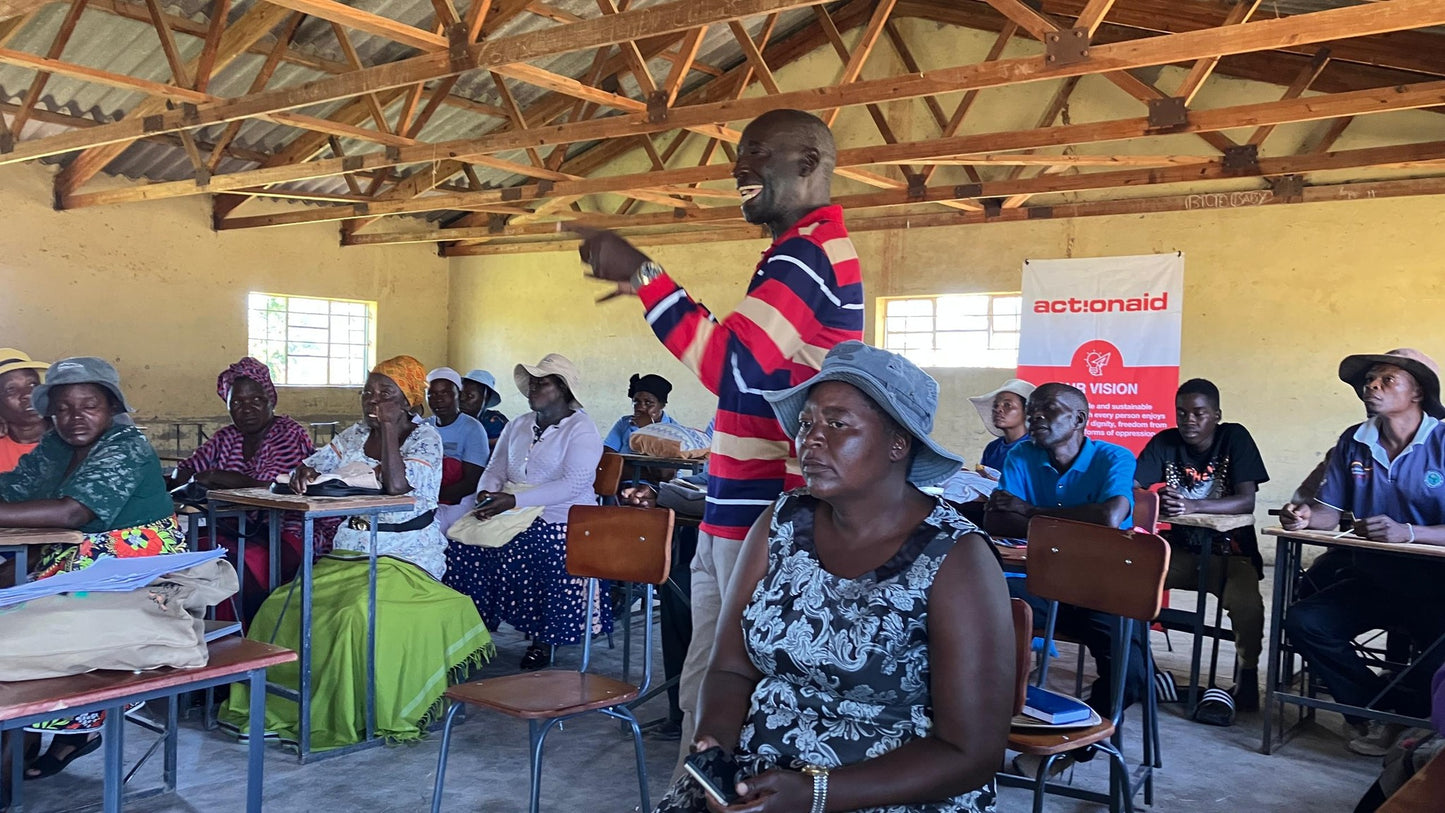
How They Work
-
Rooted in Local Rights Programme Areas
Rather than parachuting into communities for short, disconnected interventions, AAZ commits to nine specific Local Rights Programme areas over the long term, allowing genuine trust, local leadership and institutional memory to build over years rather than months.
-
Taking Sides, Not Standing Neutral
AAZ's human rights-based approach means it explicitly positions itself alongside people living in poverty, working to shift power rather than simply deliver services, a distinction that shapes everything from how projects are designed to how success is measured.
-
Partnership Across Every Level
AAZ works simultaneously with grassroots Community Based Organisations, national civil society partners such as FAWEZI, LCDZ and FACT, and government structures, recognising that lasting change requires coordinated action at the community, national and policy level all at once.