FRIENDSHIP BENCH ZIMBABWE
Mental Health Care Delivered on a Wooden Park Bench.
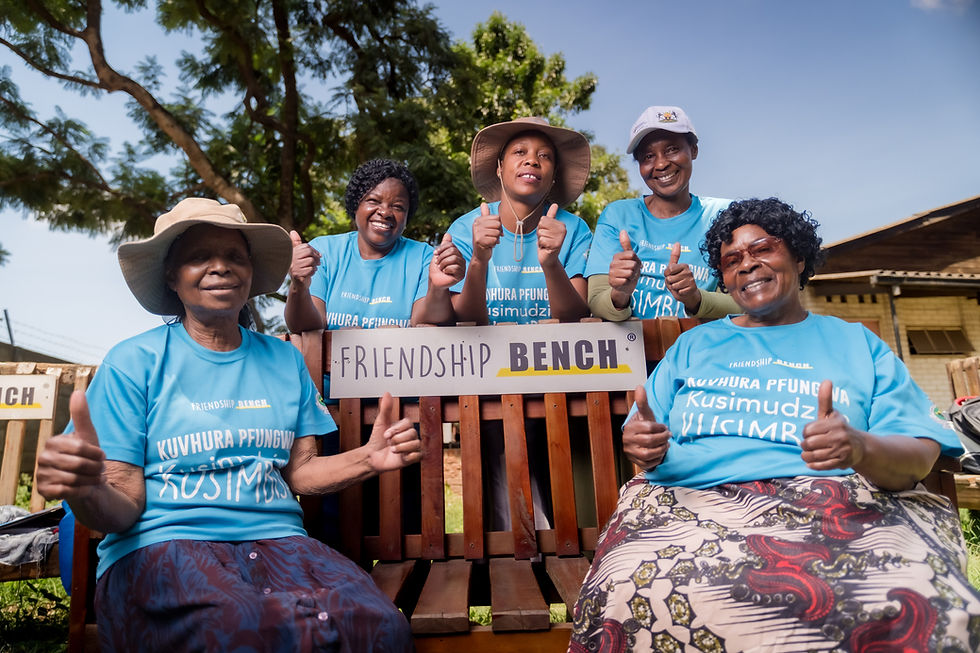
Friendship Bench Zimbabwe trains ordinary community members — many of them grandmothers — to deliver evidence-based talk therapy from wooden benches placed in discreet, safe corners of the community. It sounds almost too simple to work, but it's backed by over a decade of rigorous research, including a landmark randomised clinical trial published in the Journal of the American Medical Association (JAMA). The mission is direct: get people out of kufungisisa — "thinking too much," the Shona term for the depression and anxiety so many Zimbabweans quietly carry — and build a Zimbabwe where a Friendship Bench sits within walking distance of everyone.
Friendship Bench Zimbabwe is reimagining what mental healthcare can look like in a country with almost no psychiatrists to go around. Instead of clinics and consulting rooms, its "treatment" happens on a simple wooden park bench, sat with by a trained grandmother, in the shade of a tree, in the heart of the community. What began as one psychiatrist's small experiment in Harare has grown into a nationally embedded model that has now supported over a million people, and is being adopted by governments around the world. Fonseca connects Harare businesses and donors to a solution that is homegrown, rigorously evidenced, and built to last well beyond any single funding cycle.
Who They Are
Who They Are
Friendship Bench Zimbabwe is a Non-Governmental Organisation registered in Zimbabwe as a Private Voluntary Organisation, PVO 12/21, with the Department of Social Services. Its vision is a Friendship Bench within walking distance for everyone, and its mission is deceptively simple: get people out of kufungisisa, the Shona term for "thinking too much," used locally to describe depression and anxiety, by creating safe spaces and a sense of belonging within communities.
The model is anchored in over a decade of rigorous scientific research, including a landmark randomised clinical trial published in the Journal of the American Medical Association (JAMA), one of the most respected medical journals in the world. That evidence base is precisely what has allowed a mental health intervention delivered by grandmothers on park benches to be taken seriously by governments, universities and global health funders alike.
The Challenge: A Country With Almost No Mental Health Workforce
Zimbabwe faces a mental health treatment gap that is stark even by regional standards. At the time Friendship Bench began, the country had only a handful of trained psychiatrists serving a population of well over ten million people, the overwhelming majority of them concentrated in the capital, Harare, leaving rural and peri-urban communities with virtually no access to specialist mental health support at all.
Depression and anxiety, compounded by economic hardship, health crises and social upheaval, remain widespread across Zimbabwe, yet stigma keeps many people from seeking help, and a formal, clinic-based mental health system built solely around psychiatrists and psychologists was never going to be able to reach the people who needed it most. Friendship Bench's founder, Dr Dixon Chibanda, has spoken candidly about his own early scepticism, admitting he initially doubted that grandmothers without formal medical training could deliver an effective mental health intervention, a very Western, biomedical assumption that the programme's results would go on to overturn entirely..
From Research to National Policy
Friendship Bench's evolution over two decades tells a story of deliberate, evidence-led scale-up: from a small research pilot, to real-world validation through rigorous clinical trials, to structured national scale-up, and now to full system integration through phased technical assistance and formal government transition. Since 2019, Friendship Bench Zimbabwe has partnered directly with the Government of Zimbabwe's Ministry of Health and Child Care under the country's National Strategic Plan for Mental Health Services, specifically under Objective 2 (improving mental health awareness and community empowerment), where the Friendship Bench has been formally adopted as a Ministry of Health and Child Care programme. Friendship Bench Zimbabwe is now in the process of handing its model over to the Government of Zimbabwe entirely, positioning government as the long-term "doer at scale" nationally, a deliberate strategy to ensure the intervention's reach outlasts any single organisation or donor relationship. Since 2000, the organisation has also worked with the World Health Organization Zimbabwe office to support the WHO's Special Initiative for Mental Health.
The model's credibility rests on genuine scientific rigor, including a randomised clinical trial published in JAMA, "Effect of a Primary Care–Based Psychological Intervention on Symptoms of Common Mental Disorders in Zimbabwe," led by Dr Dixon Chibanda alongside researchers from the London School of Hygiene & Tropical Medicine and other international institutions. That evidence base is also what has driven the model's expansion well beyond Zimbabwe's borders, with the Friendship Bench approach now being adapted and implemented in other countries around the world through its global arm, Friendship Bench Global.
Recognition
Recognition
Friendship Bench Zimbabwe has been named to the Happier Lives Institute's Top Charities list for 2025, a distinction awarded to organisations whose interventions are shown, through rigorous evidence, to deliver outsized improvements in wellbeing relative to their cost, a recognition that speaks directly to just how efficiently this simple, community-rooted model turns support into genuine, measurable change in people's lives.
Partners and Supporters
Friendship Bench Zimbabwe's current funders include the DRK Foundation, the Mulago Foundation, the Schooner Foundation, Boehringer Ingelheim, and Rippleworks, among other current supporting organisations. Past funders and research partners have included Grand Challenges Canada, SolidarMed, the Inner Foundation, Zoom Cares, the London School of Hygiene & Tropical Medicine, UNAIDS, Yield Giving, the Global Alliance for Chronic Diseases, the UK Medical Research Council, Evolve, OPHID, King's College London, the Wellcome Trust, the Liverpool School of Tropical Medicine, the US National Institutes of Health, the Children's Investment Fund Foundation, and the Risk Pool Fund. Friendship Bench has worked in close partnership with Zimbabwe's Ministry of Health and Child Care since 2019 and with the World Health Organization since 2000, embedding its model within Zimbabwe's official national mental health strategy.
Why Your Support Matters
Every contribution channelled through Fonseca to Friendship Bench Zimbabwe helps train another grandmother, place another wooden bench in another community, and give another person struggling with kufungisisa somewhere safe to sit and be heard. This is an intervention proven, through some of the most rigorous research standards in global health, to work, and proven, through two decades of careful scale-up, to be sustainable well beyond the life of any single grant. Supporting Friendship Bench means investing in a uniquely Zimbabwean solution to a universal problem, one now being adopted well beyond Zimbabwe's own borders, because it turns out that some of the world's best mental healthcare doesn't require a psychiatrist's office at all, just a bench, a willing ear, and a grandmother who has learned how to truly listen.
Share

Their Impact (as of April 2026)
Bringing Mental Health to Communities
Friendship Bench has trained 2,773 community health workers, embedding mental health capacity directly into communities across Zimbabwe rather than concentrating it in a handful of urban clinics.
Their Impact (as of April 2026)
Scaling Mental Health Access
More than 1,093,104 clients have been seen on the Friendship Bench, a scale of reach that would have been unimaginable through a conventional, psychiatrist-led model.
Their Impact (as of April 2026)
Sustaining Recovery Through Community
995 Circle Kubatana Tose peer support groups are currently active, sustaining recovery long after formal therapy sessions end.
Their Impact (as of April 2026)
Delivering Measurable Impact
Clients who complete the Friendship Bench intervention have experienced a 78% reduction in depression and suicidal ideation, and a 60% improvement in overall quality of life.
How the Friendship Bench Works
-
Task-Shifting Talk Therapy
Friendship Bench trains community health workers, most often grandmothers already trusted and respected within their communities, in basic Cognitive Behavioural Therapy, with a particular emphasis on Problem Solving Therapy, activity scheduling, and peer-led group support. This task-shifting approach, moving care from scarce specialists to trained lay health workers, allows the organisation to deliver an effective, affordable and genuinely sustainable solution to Zimbabwe's mental health treatment gap at the primary care level.
-
Screening and One-on-One Support
People seeking support are screened using the Shona Symptom Questionnaire (SSQ-14), a locally validated diagnostic tool. Those who score above the clinical cut-off are invited to sit down for one-on-one Problem Solving Therapy, delivered outdoors, on a simple wooden bench, in a discreet, safe corner of their own community, deliberately removed from the clinical, stigmatising feel of a hospital setting. During training, a clear referral pathway is also established for more serious "red flag" cases that require a higher level of professional care.
-
Income Generation Through Craft:
Inside CKT groups, members are also taught to crochet items from recycled plastic bags and old VHS tape ribbon, upcycled materials transformed into bags, hats and mats that are then sold within the community. In a country facing sustained economic distress, this income-generating dimension turns a support group into something more: a source of financial resilience and pride that reinforces every other part of a person's recovery.
-
Circle Kubatana Tose (Holding Hands Together)
After completing one-on-one therapy, clients are welcomed into Circle Kubatana Tose, or CKT, a peer-led support group where people who have all sat on the Friendship Bench continue to support one another, drawing strength from shared community and experience. These groups reduce stigma and reinforce the coping skills developed during individual sessions, helping recovery outlast the initial course of therapy.